What Happens When the Salary Stops? A Practical Retirement Planning Guide
Retirement planning is not only about building a large corpus. Learn how to balance today’s family responsibilities with saving, protection, investing, and future income planning.

Table of contents
A salary gives structure to financial life. Every month, money arrives, bills are paid, responsibilities are handled, and whatever remains can be saved or invested.
Retirement changes that rhythm.
One day, the regular salary may stop, but groceries, electricity, healthcare, home maintenance, family commitments, and everyday living do not. That is why retirement planning should begin with a broader question than “How much money do I need?”
A better question is:
How can I build a financial system today that still supports my family when my salary is no longer the main source of income?

Retirement Planning Is Bigger Than a Final Corpus
A retirement corpus matters, but it is only one part of the picture.
A practical retirement plan usually has to balance several needs at the same time:
Current household expenses
Emergency savings
Health protection
Life insurance while others depend on your income
Long-term investing
Debt repayment
Future family goals
A plan for regular income after retirement
This is where many people feel stuck. They may understand that retirement is important, but today’s responsibilities already consume most of their attention.
The answer is not necessarily to wait until life becomes easier. For many families, there may never be a perfect year with no EMIs, no medical expenses, no school costs, and no unexpected obligations.
The more practical approach is to start with what your current income can realistically support.
Start With an Amount You Can Continue

People often postpone investing because the amount they can begin with feels too small.
Suppose someone can currently set aside only ₹1,000 per month.
That is ₹12,000 in one year. Over 40 years, the amount contributed would total ₹4.8 lakh before considering any investment gain or loss.
The important lesson is not that a particular investment will turn that money into a guaranteed amount. It will not. Market-linked returns vary, and losses are possible.
The useful lesson is simpler: starting creates a habit and gives long-term money more time to work.
When income rises later, the contribution can also rise.
Think in stages instead of one perfect number
For example, a person might begin with:
₹1,000 per month today
Increase the amount after a salary revision
Redirect part of a finished EMI toward retirement
Add part of a bonus rather than spending the entire bonus
Review the contribution once a year
A small contribution that survives real life can be more useful than an ambitious contribution that is cancelled after three months.
Protect the Plan Before Chasing Returns
Building wealth without protecting the household can leave the plan vulnerable.
Imagine investing consistently for several years and then needing to sell long-term investments because of a medical emergency or a sudden period without income.
That is why retirement planning also involves protection.
Keep emergency money accessible
An emergency fund is meant to handle financial shocks without forcing every unexpected expense onto a credit card or long-term investment.
The right amount will vary by household. A family with one income, dependent parents, variable employment, or large fixed commitments may need a different cushion from a dual-income household with fewer obligations.
The key is to separate emergency money from long-term retirement money.
Understand what health insurance is protecting
Health insurance is not an investment return. Its role is different: reducing the risk that a major eligible medical expense consumes savings that were meant for other goals.
Policy terms matter. Waiting periods, exclusions, co-payments, deductibles, limits, networks, and claim conditions can differ, so buyers should read the actual policy documents rather than relying only on marketing summaries.
Use life insurance for the right problem
For an earning member with financial dependants, life insurance is primarily about replacing financial support if that income disappears.
Pure term insurance and return-of-premium variants solve this in different ways and at different costs. A higher premium does not automatically make one option better; the choice should depend on the protection needed, affordability, policy terms, and personal priorities.
Plan for the Day Income Changes Form

Before retirement, your financial life is mainly about accumulation.
After retirement, the question changes:
How will the money I built support monthly life?
A person may retire with savings, investments, provident-fund proceeds, deposits, or other assets. Seeing a large lump sum can feel reassuring, but a lump sum is not automatically a monthly-income plan.
A useful way to think about retirement money is by purpose.
Near-term money
This is money needed for everyday expenses and emergencies in the relatively near future. Liquidity matters more than chasing the highest possible return.
Stability and income
Some retirees may use products such as fixed deposits for a portion of their money because periodic interest can be easier to understand and plan around.
However, actual FD rates change, interest may be taxable, premature-withdrawal rules vary, and reinvestment rates can be different when a deposit matures.
Longer-term money
Retirement can last many years. Keeping every rupee focused only on immediate income may ignore future inflation and longevity.
This is why retirement planning often works better when money has different jobs rather than being placed into one single product.
Do Not Forget Inflation
A retirement plan should not assume that today’s monthly expenses will stay unchanged forever.
Food, utilities, transport, healthcare, services, and lifestyle costs can rise over time. Even if a household’s lifestyle remains modest, the same amount of money may buy less in future years.
Instead of trying to predict every future price perfectly, build flexibility into the plan:
Review retirement expenses periodically
Keep some room for healthcare and home costs
Revisit income sources when rates or circumstances change
Avoid committing the entire corpus to one rigid arrangement
Maintain a separate emergency reserve
The goal is not a perfect forecast. It is a plan that can be adjusted.
Your Family Needs to Understand the Plan Too
A financial system is fragile if only one person knows how it works.
Your spouse or another trusted family member should know where important financial information is stored, including:
Bank and investment accounts
Insurance policies
Loans
Nominee or beneficiary information
Important documents
Key contacts
The basic retirement-income plan
This does not mean sharing passwords casually. It means making sure the family would know what exists and where to begin if the person who normally manages the finances could not do so.
Retirement Planning Should Include Living
There is another side of retirement planning that receives less attention: eventually, the money is meant to support a life.
For years, parents may prioritize children, housing, education, medical needs, and family obligations. Later, children may become financially independent and major loans may end.
At that stage, retirement planning can also make room for travel, hobbies, family experiences, home improvements, and ordinary enjoyment—while still protecting essential reserves.
The objective is not to preserve every rupee forever. It is to create enough financial independence that spending decisions are made with confidence rather than fear.
A Simple Starting Framework
You do not need to solve your entire retirement today.
Start with these five questions:
What does my household currently cost each month?
How much emergency cash do we have?
Are our major health and life risks reasonably protected?
What amount can I invest consistently for retirement right now?
How might those savings eventually become usable retirement income?
Then review the answers regularly as salary, family responsibilities, debt, and goals change.
Retirement planning is not a one-time calculation. It is an evolving system.
The Next Step
If this article made you think beyond simply “saving a big amount,” that is a useful first step.
When the Salary Stops expands this idea into a structured family-finance journey, with practical examples, retirement-income concepts, protection discussions, case studies, checklists, and planning worksheets—without treating investment returns as guaranteed.
Explore the ebook here:
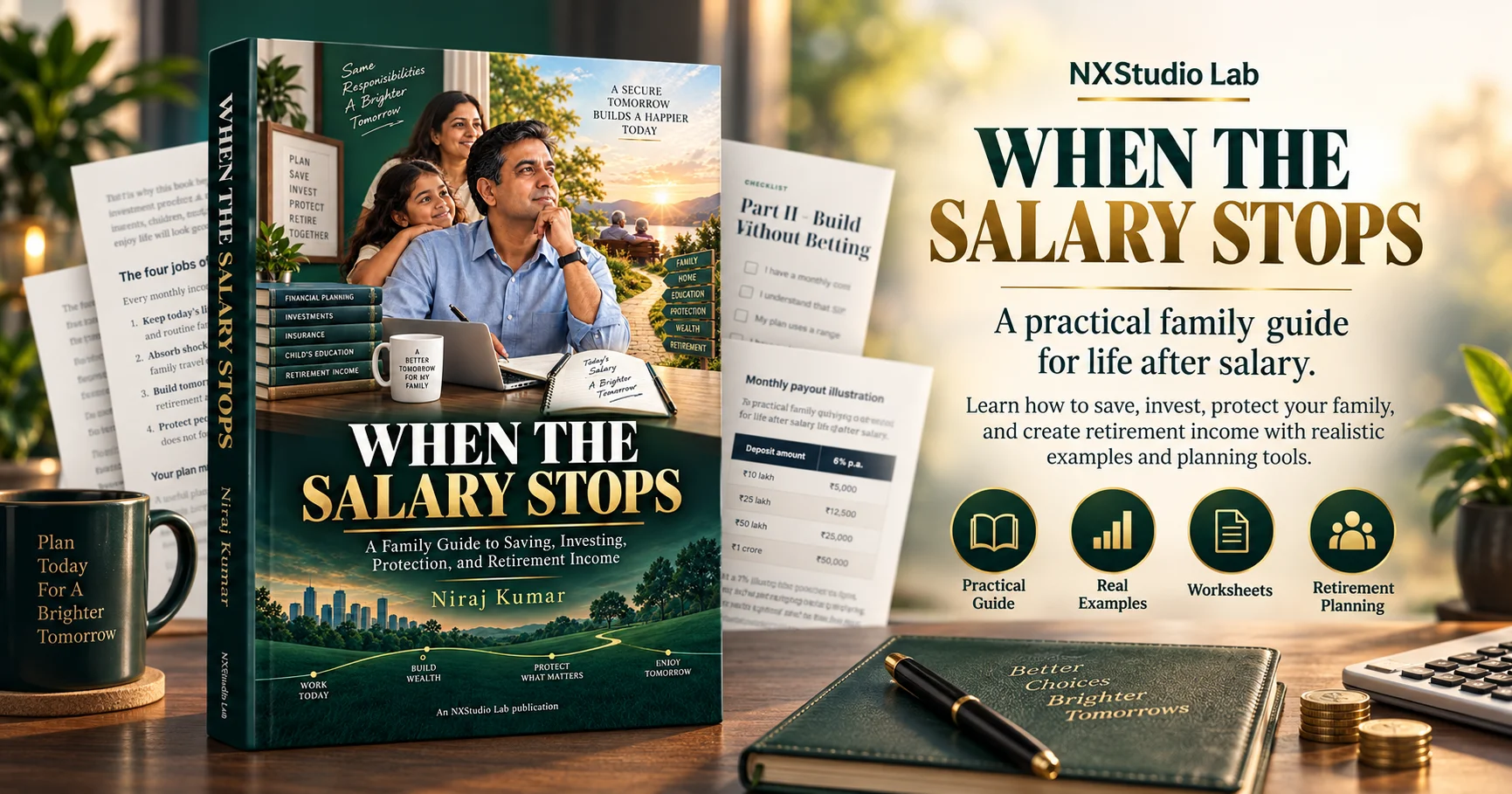 nxstudio.inWhen the Salary Stops | Retirement Planning Ebook — NXStudio LabA practical family retirement planning ebook covering saving, SIPs, protection, insurance, FD income, retirement cash flow, and worksheets.
Start with the amount and information you have today. The plan can become more sophisticated later; the important thing is to begin building a system your future household can actually use.