I Applied to 147 Jobs and Heard Nothing—Until a Hiring Manager Showed Me His Screen
At 1:40 AM on a Tuesday, Rohit stared at his spreadsheet: 147 job applications sent, zero interview calls. Three weeks later, he had 4 interviews in 10 days. Here is the exact shift that changed everything.

Table of contents
It was 1:40 AM on a rainy Tuesday in Bengaluru when my friend Rohit sent me a screenshot of his Google Sheet. Column A listed 147 companies across LinkedIn Easy Apply, Naukri, and company career portals. Column F—labelled "Interview Calls"—was completely blank.
Rohit wasn't underqualified. He had three years of solid hands-on experience, clean project deliveries, and a genuine hunger to grow. Yet every morning began with the same demoralizing routine: refresh Gmail, read two automated "Unfortunately, we have decided to move forward with other candidates" emails, and panic-apply to twelve more openings before logging into work.
The Coffee Chat That Exposed the "Resume Black Hole"
That weekend, Rohit met Arjun, an engineering manager at a mid-sized product company, for coffee. Halfway through the conversation, Arjun opened his laptop and pulled up the backend dashboard of their Applicant Tracking System (ATS) for a single open role posted 48 hours earlier.
"We received 1,140 applications in two days," Arjun said, pointing at the screen. "I don't read 1,140 PDFs. I type four mandatory skill keywords and a notice-period filter into the search bar, and I look at the top 25 matches—plus the 6 candidates my team referred directly on Slack."
When Arjun pulled up Rohit's actual resume on screen, the problem became painfully obvious in six seconds:
His two-column graphic template had scrambled his work dates and skills into an unreadable single paragraph inside the ATS parser.
Every bullet point read like a passive job description ("Responsible for handling client escalations") instead of proving measurable business impact.
He was spending 100% of his energy competing with 1,100 strangers on public portals—and 0% of his energy sending warm, high-context referral notes to insiders.
Turning Those Notes Into a Repeatable System
Over the next forty-eight hours, we tore down Rohit's entire job-hunt workflow. We rebuilt his resume in a single-column parser-safe layout using the [Action Verb] + [Scope] + [Metric] + [Method] formula. We rewrote his LinkedIn headline and Naukri profile summary so recruiter search filters actually ranked him on page one. And instead of clicking "Easy Apply" thirty times a day, he sent five short, respectful 75-word referral messages every evening to alumni and hiring managers.
The result? No magic overnight miracle—and no fake "100% job guarantee"—just math working in his favor. Within ten days, two engineers referred him internally, one recruiter called him directly from Naukri search, and he walked into four first-round interviews with a prepared bank of eight STAR+L stories.
Because so many friends and readers asked for the exact templates, word-for-word scripts, and AI prompts we used during that sprint, I compiled the entire system into The Smart Job-Hunt Playbook.
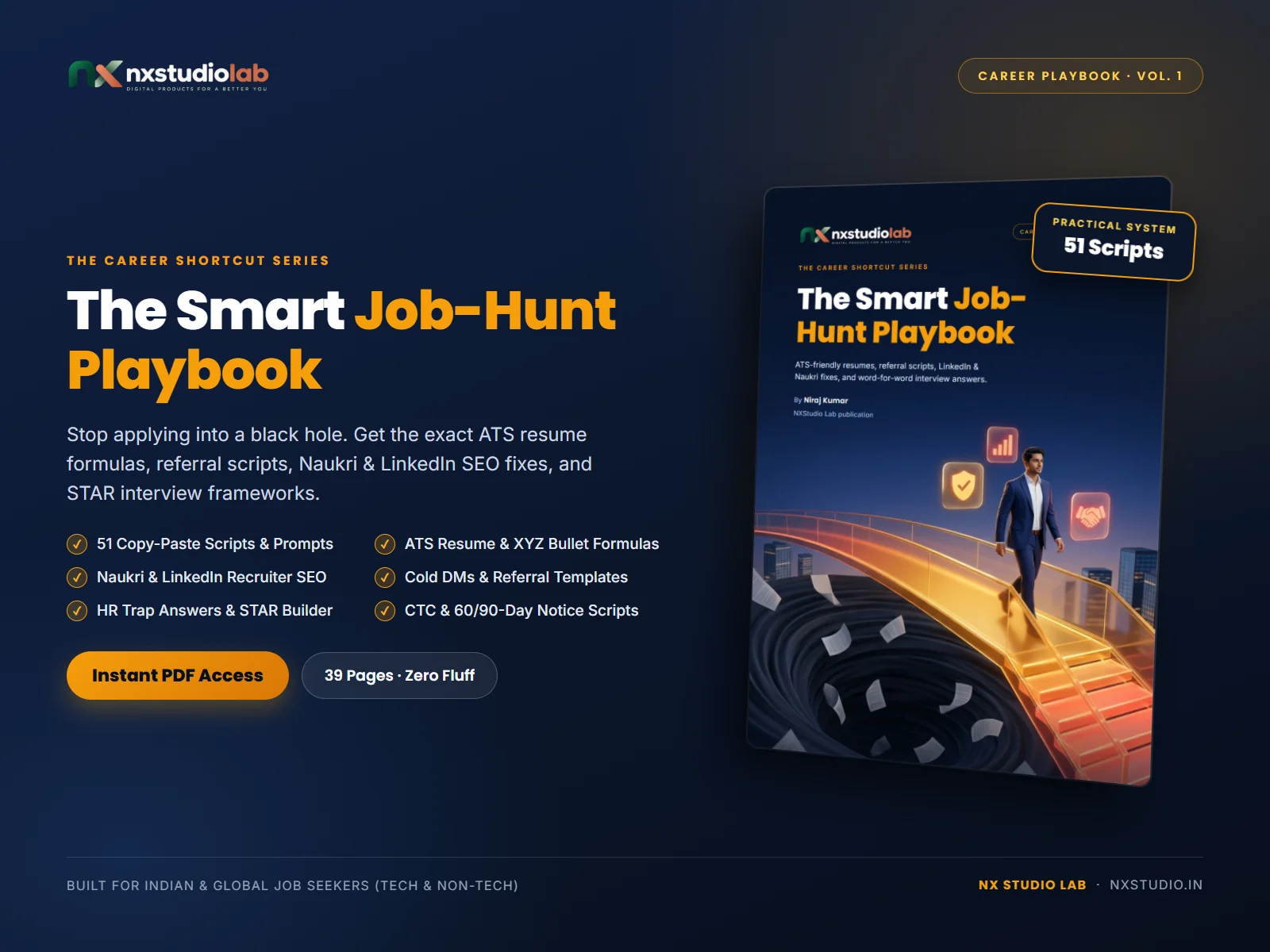 nxstudio.inThe Smart Job-Hunt Playbook — Resume, Referral & Interview Scripts — NXStudio LabPractical 39-page career playbook with 51 copy-paste referral scripts, ATS resume formulas, Naukri & LinkedIn SEO, and STAR interview answers.
4 Shifts You Can Make Tonight Before Sending Another Resume
Even if you only have thirty minutes tonight, stop mass-applying and run this four-step audit on your current approach:
1. Run the 5-Second Plain-Text Paste Test
Open your resume PDF, press Ctrl+A, copy everything, and paste it into a blank Notepad file. If your section headings, dates, or bullet points merge together or appear out of order, automated ATS parsers are misreading your profile before a human ever sees it.
2. Replace Duties With the XYZ Impact Formula
Never write "Worked on backend APIs" or "Managed social media campaigns." Rewrite your top five bullets using: Accomplished [X] as measured by [Y], by doing [Z]. Even rough estimates—like reducing turnaround time by ~25% or handling 40+ weekly tickets—build instant credibility in a 6-second recruiter scan.
3. Treat LinkedIn and Naukri Like Search Engines
Recruiters don't browse profiles randomly; they search by exact role titles, core tools, location, and notice period. Place your target role title, top three hard skills, and domain right in your headline—and update a minor line on your Naukri profile around 9:00 AM IST on weekdays so you surface in the "Recently Updated" filter.
4. Never Ask "Can You Refer Me?" Without a Job ID and 3-Line Pitch
Busy employees ignore vague messages like "Hi bro, any openings?" When you reach out for a referral, do the heavy lifting for them: include the exact Job ID or link, a two-sentence summary of why your recent project matches their team's stack, and your tailored resume attached.
Stop Guessing in the Dark
Job hunting in a competitive market is exhausting when you receive zero feedback. You don't need luck or false promises—you need a structured pipeline, parser-proof positioning, and the right words when a recruiter or hiring manager finally opens your message. Start with the 14-day daily 90-minute routine, track every touchpoint, and give your skills the visibility they deserve.