7 Screen-Free Indoor Activities for Kids Ages 5–8
Looking for ways to keep kids entertained without another screen? Discover 7 simple indoor activities for ages 5–8 that encourage creativity, movement, imagination, and family fun—including an exciting printable treasure hunt adventure.
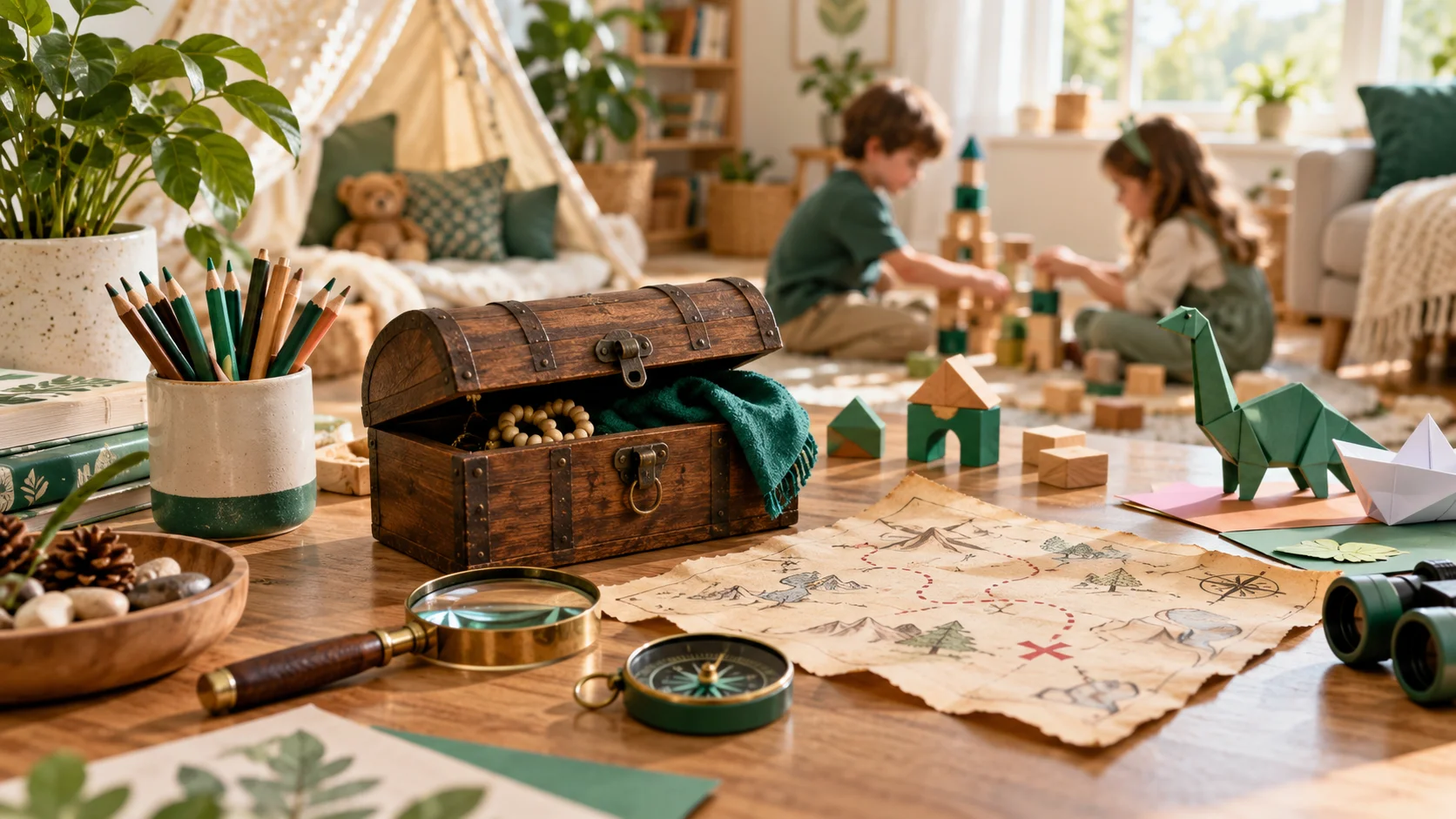
Table of contents
Keeping kids entertained indoors can sometimes feel harder than it should.
When the weather keeps everyone inside, school is out, or you hear the familiar “I’m bored”, reaching for another cartoon or game can feel like the easiest option.
But screen-free time doesn’t have to mean complicated crafts or hours of preparation.
With a few simple ideas, an ordinary afternoon at home can become a creative challenge, an active game, or even a little adventure.
Here are 7 screen-free indoor activities for kids ages 5–8 that encourage imagination, movement, creativity, and family fun.
1. Turn Your Home Into a Treasure Hunt
Few indoor activities create excitement quite like a treasure hunt.
A familiar living room can suddenly become somewhere to explore. A hidden surprise creates anticipation, and every new discovery gives children a reason to keep going.
Treasure hunts are especially fun because they can combine:
Movement
Observation
Imagination
Problem-solving
A little mystery
The challenge for parents is usually the preparation.
Creating an interesting experience from scratch means thinking about the theme, planning the activity, preparing everything, and making sure it stays suitable for your child’s age.
If you love the idea but would rather skip most of the preparation, The Great Indoor Treasure Hunt is a ready-to-print activity kit designed for kids ages 5–8.
 nxstudio.inThe Great Indoor Treasure Hunt – Printable Activity Kit for Kids Ages 5–8 — NXStudio LabPrintable treasure hunt kit for kids ages 5–8 with 3 ready-made adventures, reusable clues, puzzles, challenges and activities for indoor play.
2. Create an Indoor Obstacle Challenge
You don’t need a large playroom to get children moving indoors.
Use safe areas around your home to create a simple movement course.
Children could:
Walk along an imaginary line
Move around cushions
Crawl through a safe space
Balance for a few seconds
Hop from one point to another
Complete a funny movement before reaching the finish
The goal doesn’t need to be speed or competition.
Simply changing how children move through a familiar space can make the activity feel completely different.
You can also rearrange the challenge the next time you play so it never feels exactly the same.
3. Build Something From Everyday Materials
Sometimes the best creative activities start with things you already have at home.
Give children a selection of safe materials such as paper, cardboard, paper cups, craft sticks, child-safe tape, or recyclable packaging.
Then give them a challenge instead of step-by-step instructions.
Try questions like:
Can you build the tallest tower?
Can you make a house for your favourite toy?
Can you invent your own vehicle?
Can you create something that holds five small objects?
Can you build a bridge between two objects?
There is no need for the final creation to look perfect.
The fun comes from deciding what to build, experimenting with ideas, and discovering what works.
4. Start a Family Drawing Challenge
Drawing becomes much more exciting when everyone is given an imaginative prompt.
Choose one idea and let each person create their own version.
You could try:
Design your dream treehouse
Draw an animal that doesn’t exist
Create your own superhero
Imagine a city in the clouds
Design the world’s strangest robot
Draw your dream bedroom
Invent a magical vehicle
Parents can participate too.
Once everyone finishes, take turns explaining the drawings.
Instead of deciding which picture is “best,” focus on the ideas behind each creation.
It turns a simple drawing activity into storytelling, imagination, and family conversation.
5. Play the Mystery Bag Game
This is one of the easiest activities to prepare.
Place several safe household objects inside a bag where children cannot see them.
Let them reach inside, feel one object, and try to identify it without looking.
Before guessing, encourage them to describe what they can feel.
Ask questions such as:
Is it soft or hard?
Is it smooth or rough?
Is it round or flat?
Does it feel heavy or light?
Is it bigger or smaller than your hand?
You can make the activity easier or more challenging depending on your child’s age.
For another round, let your child choose the mystery objects and challenge you instead.
6. Try an Indoor Scavenger Search
A scavenger search turns familiar surroundings into an observation game.
Instead of asking children to find one exact object, give them a description or category.
Ask them to find something that is:
Soft
Round
Green
Smaller than their hand
Made from paper
Something they use every day
Something with a number on it
Something that makes a sound
Something beginning with a particular letter
For younger children, keep the descriptions simple.
Older children may enjoy more unusual or imaginative categories.
Before starting, make sure everyone knows which rooms and objects are safe to explore.
7. Create a Story Together
You don’t need books, cards, or equipment for this activity.
Start with one sentence:
“Behind the old door, we discovered…”
Then let the next person add another sentence.
Continue taking turns until your family has created an entire story together.
The story doesn’t have to make perfect sense.
In fact, unexpected twists usually make it more entertaining.
To make the activity even more fun, choose a few things that must appear somewhere in the story.
For example:
A mysterious key
A hidden treasure
A talking animal
A secret map
An explorer
A strange sound
A surprising visitor
Once the story is finished, children can draw their favourite scene from the adventure.
Screen-Free Activities Don’t Need to Be Complicated
Keeping children engaged doesn’t always require expensive toys, elaborate crafts, or hours of preparation.
Sometimes a simple idea is enough to completely change an afternoon.
A sheet of paper can become an invention.
A cardboard box can become a building challenge.
A living room can become an obstacle course.
And an ordinary home can become the setting for an adventure.
The important part is giving children something they can actively participate in, rather than something they only watch.
Make Screen-Free Time Easier to Prepare
Some days you may enjoy creating activities from scratch.
Other days, you simply want something fun that has already been prepared for you.
If your child enjoys exploring, mysteries, challenges, and surprises, The Great Indoor Treasure Hunt is designed to help turn an ordinary day at home into a memorable adventure.
Created for children ages 5–8, the printable kit makes it easier for parents to prepare an engaging indoor activity without having to design the entire experience themselves.
Print it, prepare the adventure, and let your young explorer begin.
Discover The Great Indoor Treasure Hunt →
Looking for more creative printables, ebooks, and useful digital resources? Explore more from NXStudio Lab.