How to Create a Learning Routine That Actually Sticks
Build a learning routine you can actually maintain with simple strategies for planning, consistency, practice, weekly reviews, and busy days.
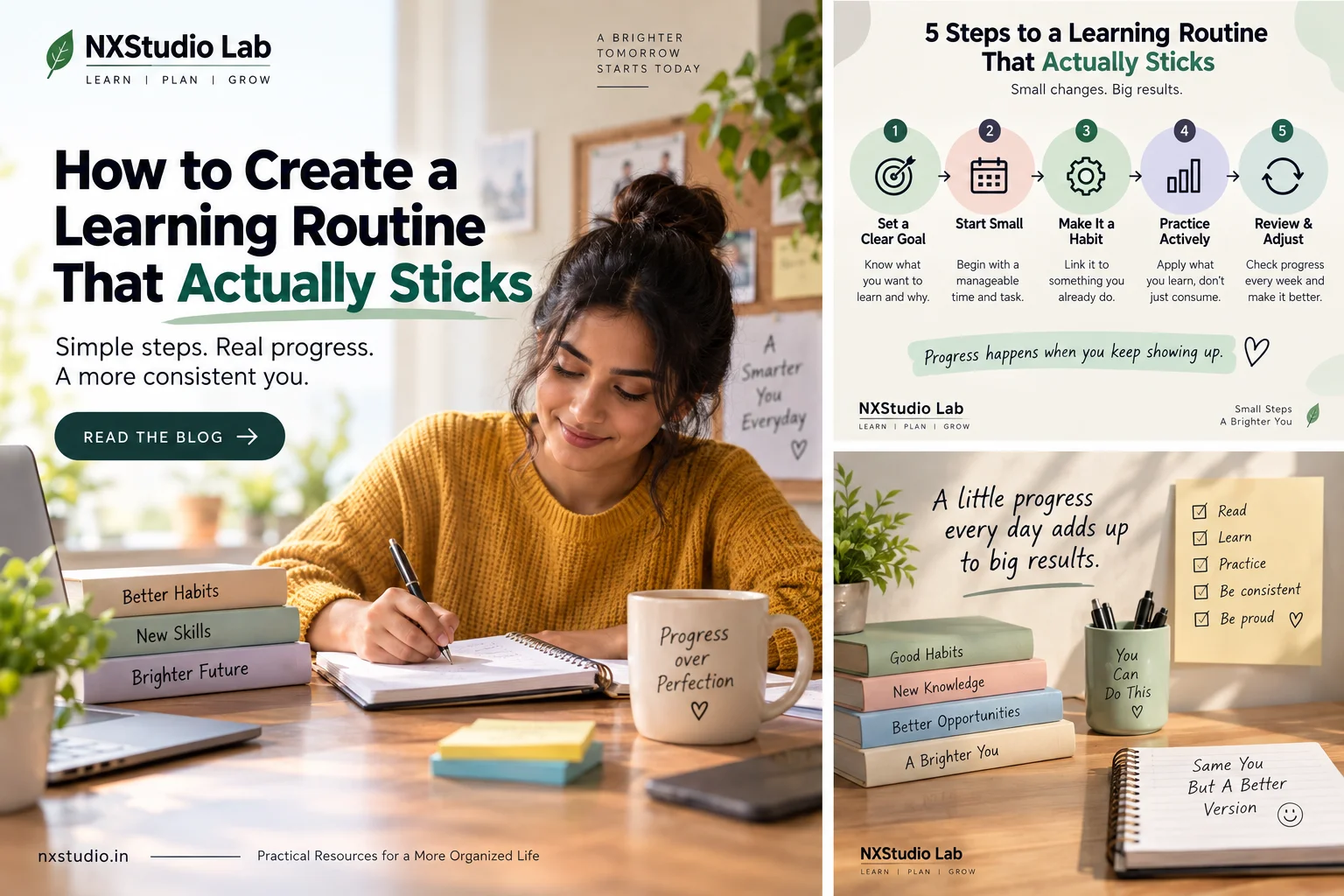
Table of contents
Starting a new learning routine is easy.
Sticking to it is the difficult part.
You may begin with a new course, a fresh notebook, a long study schedule, or a list of goals. For the first few days, everything feels exciting. Then work gets busy, motivation drops, one session gets skipped, and the routine slowly disappears.
The problem is often not a lack of discipline.
The problem is that the routine is too difficult to maintain.
A useful learning routine should fit into your real life, not an imaginary perfect schedule. Here is a simple way to build one that you can actually continue.
1. Start With a Clear Learning Goal
Avoid vague goals such as:
“I want to learn coding.”
“I want to improve English.”
“I want to study more.”
Instead, define what progress should look like.
For example:
“Complete three lessons of my React course every week.”
“Practice spoken English for 20 minutes each day.”
“Finish one chapter of my exam syllabus every two days.”
A clear goal makes it easier to decide what you need to do next.
You do not need to plan the entire journey. You only need enough clarity to know what your next few learning sessions should contain.
2. Make the Routine Smaller Than You Think
One of the biggest mistakes people make is creating an ambitious schedule at the beginning.
You might decide to study for two hours every evening.
That may work for three days.
But what happens when you are tired, busy, travelling, or simply not in the mood?
A smaller routine is easier to repeat.
Try starting with:
15 minutes of reading
One short lesson
Five practice questions
One page of notes
Ten minutes of revision
You can always continue if you have more energy.
The goal is to make starting feel easy.
3. Attach Learning to Something You Already Do
A routine becomes easier when it has a clear trigger.
Instead of saying:
“I will study sometime in the evening.”
Try:
“I will study for 20 minutes after dinner.”
Or:
“I will revise yesterday's notes after my morning tea.”
Or:
“I will watch one lesson after I open my laptop for the day.”
This gives your brain a predictable sequence:
Existing habit → Learning session
You spend less time deciding when to start.
4. Choose a Consistent Learning Window
You do not necessarily need to study at exactly the same minute every day.
But having a regular learning window helps.
For example:
Morning: 7:00–7:30 AM
Lunch break: 1:30–2:00 PM
Evening: 8:00–8:30 PM
Choose a time when interruptions are relatively low.
More importantly, choose a time you can realistically maintain.
A 20-minute routine you follow regularly is usually more useful than a two-hour schedule you rarely complete.
5. Decide What You Will Do Before the Session Starts
Many learning sessions are wasted because the first ten minutes go into deciding what to study.
Prepare your next task in advance.
At the end of every session, write one simple instruction for your future self.
For example:
“Tomorrow: complete lesson 6 and make notes on the three key concepts.”
Or:
“Next session: solve questions 21–35 and review incorrect answers.”
This removes friction when you return.
You can simply open your material and begin.
6. Separate Learning From Practice
Watching videos, reading books, or attending classes can make you feel productive.
But learning becomes stronger when you actively use the information.
Your routine should include both input and practice.
For example:
If you are learning a language
Learn vocabulary → Use the words in sentences.
If you are studying mathematics
Understand the concept → Solve questions without looking at the solution.
If you are learning programming
Watch the lesson → Build something small using the concept.
If you are preparing for an exam
Read the chapter → Attempt practice questions → Review mistakes.
Try to include some form of active recall, practice, or application in every learning cycle.
7. Track Consistency, Not Perfection
Missing one day does not destroy your routine.
The real problem begins when one missed day becomes several.
Use a simple tracker.
You can mark each day as:
✓ Completed
○ Light session
— Missed
The purpose is not to create a perfect streak.
The purpose is to notice patterns.
If you repeatedly miss your Tuesday evening session, perhaps Tuesday evening is simply not a good learning time.
Adjust the routine instead of assuming you lack discipline.
8. Create a Minimum Version for Busy Days
Your normal learning session might be 30 minutes.
But create a smaller backup version.
For example:
Normal day: 30 minutes
Busy day: 10 minutes
Very busy day: Review five flashcards or read one page
This keeps the habit alive.
A tiny session still reinforces the identity of being someone who regularly learns.
It also makes returning to your normal routine easier.
9. Keep Your Learning Environment Ready
Small obstacles can make starting surprisingly difficult.
If you need to search for your notebook, find your login details, charge your tablet, clear your desk, and locate the correct lesson every time, you are adding unnecessary friction.
Prepare your environment.
Keep your materials together.
Bookmark your course.
Keep your notebook nearby.
Create a dedicated folder for learning resources.
Leave your next lesson ready whenever possible.
The easier it is to begin, the more likely you are to continue.
10. Review Your Routine Once a Week
A routine should change as your life changes.
Once a week, ask yourself:
What did I complete?
What did I understand well?
Where did I struggle?
Which sessions did I skip?
Was my schedule realistic?
What should I focus on next week?
This does not need to become a long planning session.
Ten minutes is enough.
The purpose is to make small improvements before problems become habits.
Try This Simple Weekly Learning Routine
Here is a basic structure you can adapt.
Monday
Learn a new concept.
Tuesday
Continue learning and make short notes.
Wednesday
Practice what you learned.
Thursday
Learn the next concept.
Friday
Practice again.
Saturday
Review difficult areas.
Sunday
Review the week and plan the next one.
Your schedule does not need to look exactly like this.
The important part is having a repeatable cycle of learning, practice, and review.
A Simple Rule to Remember
Do not build your learning routine around your most motivated day.
Build it around an ordinary day.
A routine that only works when you have plenty of time and energy will eventually fail.
A routine that still works when the week becomes busy has a much better chance of becoming part of your life.
Start small.
Make the next step obvious.
Practice what you learn.
Review your progress.
Then improve the routine gradually.
Consistency rarely comes from creating the perfect schedule.
It comes from creating a routine that is simple enough to return to again and again.