25 Screen-Free Activity Ideas for Kids Ages 4–8
Discover 25 simple screen-free activity ideas for kids ages 4–8, including puzzles, drawing, scavenger hunts, movement games, quiet-time play, and creative challenges for home.
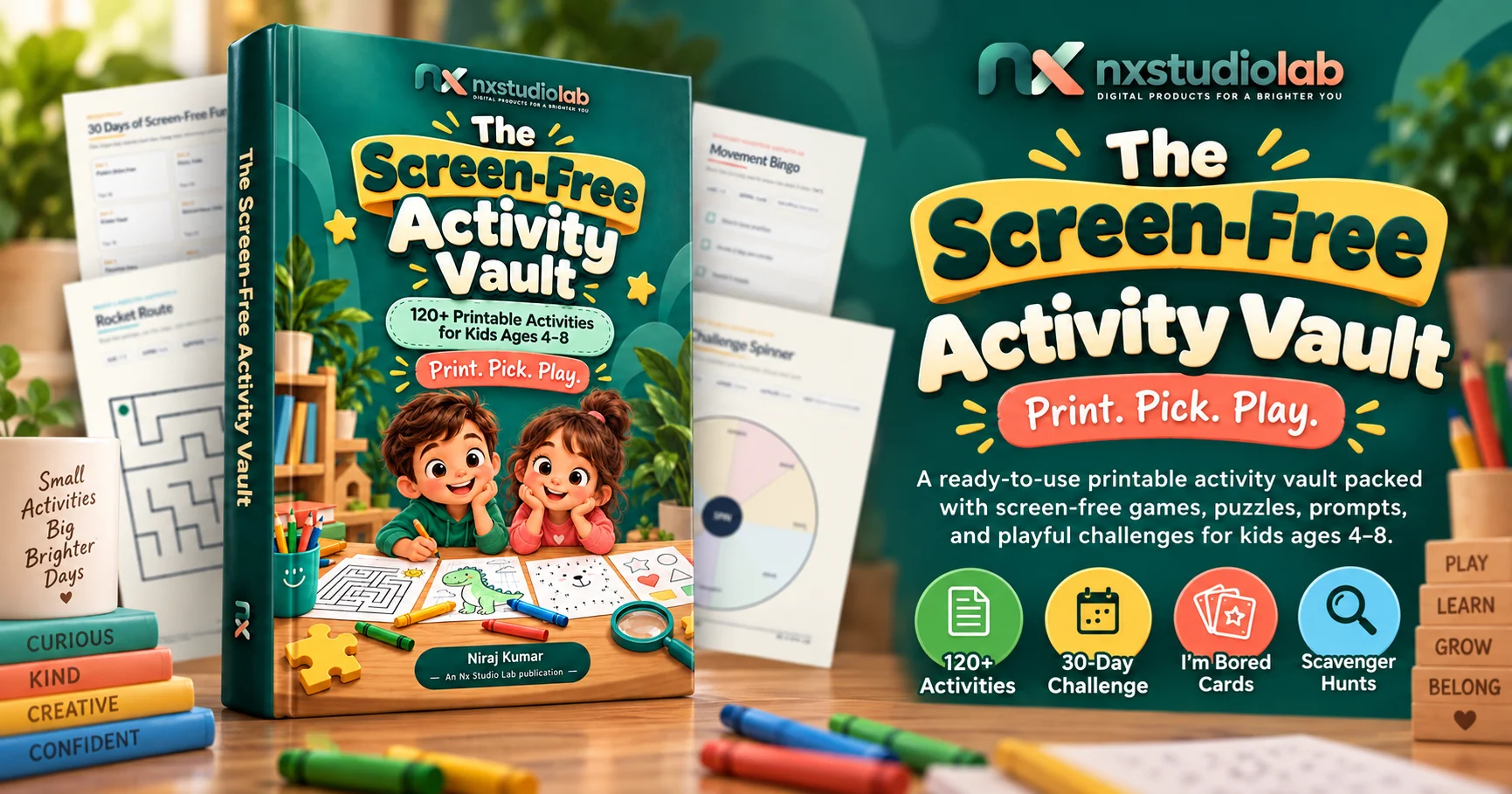
Table of contents
Why Screen-Free Activities Matter
Screen-free activities give children more opportunities to create, move, observe, solve problems, and use their imagination in different ways.
They can also give parents a practical alternative when they want to reduce passive screen time without turning the day into a structured lesson.
The key is variety.
Some days your child may want to draw. On another day, they may want a puzzle, movement game, scavenger hunt, or quiet activity.
That is why having a mix of ready-to-use ideas can make things much easier.
1. Create a Colour Hunt
Ask your child to find:
3 red objects
2 blue objects
4 green objects
1 yellow object
You can make it easier or harder depending on age.
For older children, add rules such as:
“Find something blue that is smaller than your hand.”
2. Draw a New Animal
Ask your child to invent an animal that does not exist.
Give it:
a name
a habitat
a favourite food
a special ability
This turns a simple drawing activity into an imagination challenge.
3. Build the Tallest Tower
Use safe household items such as blocks, cups, boxes, or paper.
The challenge:
How tall can you build before the tower falls?
Try again with fewer objects or a different material.
4. Make a Mini Indoor Scavenger Hunt
Give your child a short list of things to find.
For example:
something soft
something round
something shiny
something smaller than a spoon
something with a pattern
Keep the hunt inside familiar and safe areas.
5. Try a Simple Maze
Mazes are great for quiet-time play.
You can use printed mazes, hand-drawn mazes, toy mazes made with blocks, or chalk paths outdoors.
Younger children may enjoy wide, simple paths, while older children can try more complex routes.
6. Finish the Picture
Draw half of something and ask your child to complete it.
Try:
half a monster
half a robot
half a castle
half a vehicle
half a tree
The final result does not need to match your original idea.
That is part of the fun.
7. Create a Movement Challenge
Write simple actions on pieces of paper.
Examples:
hop 5 times
walk like a penguin
balance on one foot
stretch as tall as possible
move like a crab
Pick one at a time and complete the challenge.
8. Play Odd One Out
Choose four objects or draw four pictures.
Ask:
Which one does not belong?
For example:
Apple
Banana
Carrot
Orange
There can even be more than one possible answer if the child explains their reasoning.
9. Make a Sound Hunt
Sit quietly for one minute.
Ask your child to listen carefully and remember every sound they notice.
Then compare lists.
You may hear birds, a fan, footsteps, vehicles, a clock, leaves moving, or someone talking.
10. Invent a Super Vehicle
Ask your child to design a vehicle that can travel on land, float on water, and fly.
What special features would it need?
Let them draw and label their invention.
11. Sort Household Objects
Collect a small group of safe objects.
Ask your child to sort them by colour, size, shape, material, or purpose.
Then ask them to create their own sorting rule.
12. Try a Pattern Challenge
Start a pattern such as:
Circle — Square — Circle — Square — ?
Or:
Red — Blue — Blue — Red — Blue — Blue — ?
Children can continue the pattern or invent one for you.
13. Create a Three-Box Comic
Divide a sheet of paper into three boxes.
Use:
Beginning
Surprise
Ending
Children can tell an entire little story through three drawings.
14. Make a Mystery Object Game
Choose an object without showing it.
Give clues such as:
“It is small.”
“It is made of plastic.”
“We use it in the kitchen.”
Let the other person guess.
Then switch roles.
15. Try a Number Hunt
Ask your child to find numbers around the house.
Numbers may appear on clocks, calendars, books, packets, appliances, or labels.
Older children can look for specific numbers or number patterns.
16. Draw With Only Shapes
Choose three shapes:
circle
square
triangle
Now create an entire picture using only those shapes.
It could become a robot, house, animal, rocket, or something completely unexpected.
17. Create a Tiny Museum
Choose four or five safe objects.
Arrange them like a museum display.
For each object, make a small label explaining what it is, where it came from, and why it is important.
The stories can be real or imaginary.
18. Play a Memory Observation Game
Place several objects on a table.
Let your child look at them for 20 seconds.
Cover the objects.
Ask:
What do you remember?
To make it harder, remove one object and ask what is missing.
19. Design a Dream Playground
Ask your child to draw the perfect playground.
It could include giant slides, tunnels, climbing areas, secret doors, unusual swings, or imaginary play zones.
There are no limits except imagination.
20. Try Quiet-Time Doodling
Give your child a simple starting shape.
For example:
a spiral
a star
a squiggly line
three circles
Ask them to turn it into a complete picture.
This works particularly well during quiet afternoons or waiting periods.
21. Make a Safe Indoor Obstacle Route
Use safe floor markers, cushions, or open spaces.
Create instructions such as:
walk around the cushion
step over the line
crawl to the chair
balance for five seconds
finish at the door
Keep the activity simple and age appropriate.
22. Invent a New Holiday
Ask your child to create a brand-new holiday.
They can decide the holiday name, what people celebrate, what food they eat, what colours they use, and one special tradition.
Then draw a poster for it.
23. Create a Secret Symbol Code
Assign symbols to a few letters.
For example:
★ = A
● = B
▲ = C
Write a short coded message and let your child decode it.
Older children can create their own code for someone else.
24. Make a Story From Three Objects
Choose three random objects.
For example:
spoon
sock
toy car
Now invent a story that includes all three.
This can become surprisingly funny.
25. Make an “I’m Bored” Jar
Write simple activities on slips of paper.
Fold them and place them in a jar.
Whenever your child says they are bored, they pick one.
Ideas could include:
draw an imaginary animal
find five round things
build something using ten objects
create a short dance
draw a treasure map
invent a new game
This removes the need to think of an activity every single time.
The Easier Way: Keep a Ready-to-Use Activity Collection
Coming up with one screen-free activity is easy.
Coming up with a new one every day is harder.
That is why having a ready-to-print activity collection can be useful.
Instead of repeatedly searching for ideas, you can keep a mix of puzzles, creative prompts, scavenger hunts, movement games, quiet-time activities, and printable challenges ready to use.
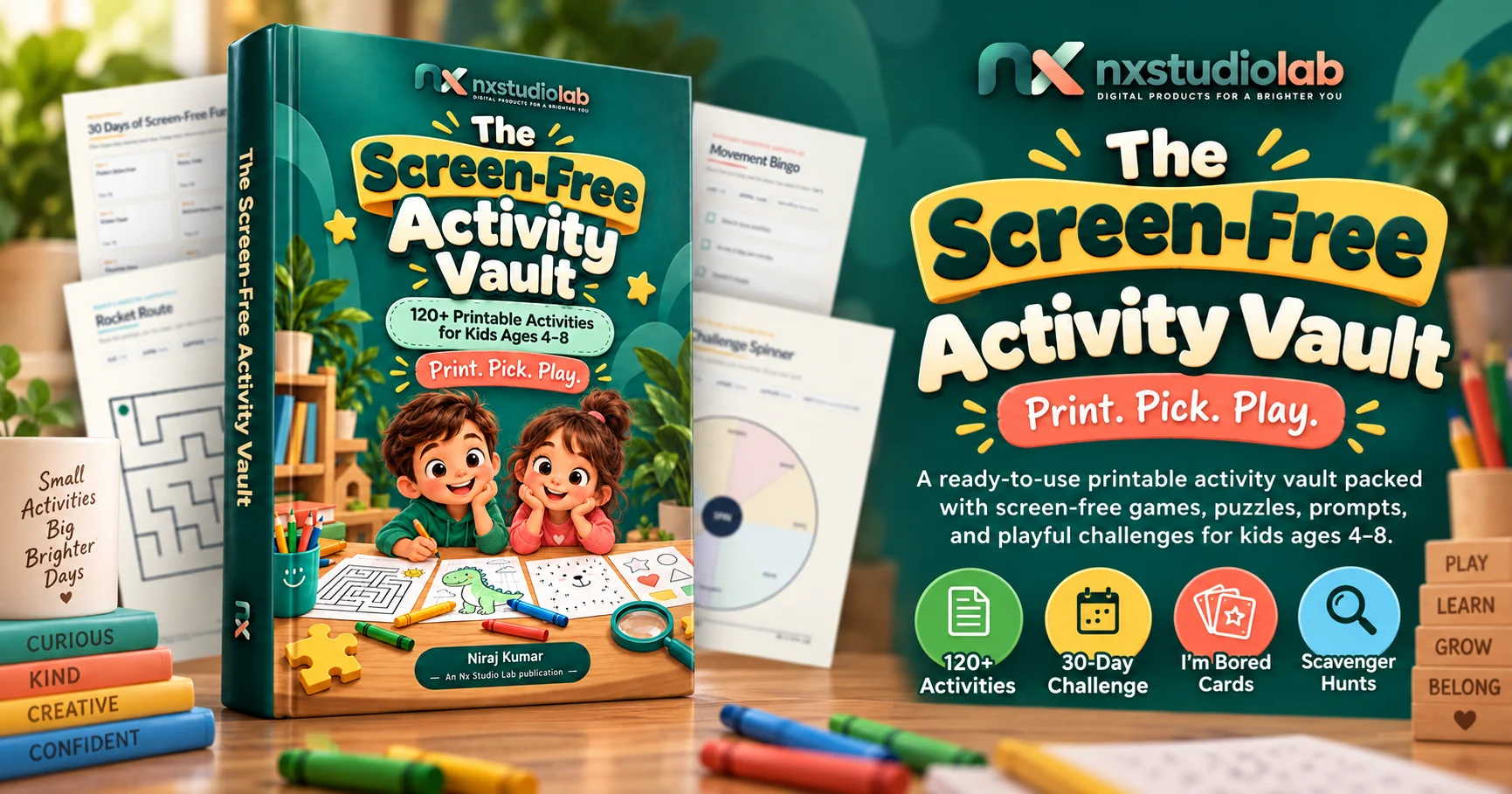
NXStudio Lab’s The Screen-Free Activity Vault was created for exactly that purpose.
It includes:
120+ printable activities and resources
Activities for ages 4–8
Brain games
Mazes and puzzles
Drawing and creativity challenges
Scavenger hunts
Movement activities
Observation games
Quiet-time activities
Cut-and-play pages
30 “I’m Bored” Activity Cards
30-Day Screen-Free Challenge
Printable reward certificates
Answer keys for activities with objective solutions
You can print only the pages you need instead of printing the complete book.
Explore The Screen-Free Activity Vault:
 nxstudio.inScreen-Free Activity Vault for Kids Ages 4–8 — NXStudio LabDiscover 120+ printable screen-free activities for kids ages 4–8, including mazes, puzzles, scavenger hunts, creative play, activity cards and a 30-day challeng
Final Thoughts
Screen-free time does not need to mean complicated crafts, expensive toys, or hours of preparation.
Often, the best activities are simple:
Find something. Build something. Draw something. Solve something. Move. Imagine.
Having a few ideas ready can make those everyday “I’m bored” moments much easier to handle — and much more fun.
For parents who want a larger ready-to-use collection, The Screen-Free Activity Vault brings those ideas together in one printable system designed for kids ages 4–8.